
Will Your Insurance Company Drop You Because of Your Roof's Age?
A roof can keep the rain out and still cause trouble with your homeowners insurance.
Across Michigan, insurance carriers are paying closer attention to the age, condition, installation history, and remaining service life of roofs. There is no universal cutoff that applies to every company. However, 15 and 20 years have become common review points. Around 15 years, a carrier may request photographs, an inspection, or installation records. As a roof approaches or passes 20 years, the company may restrict coverage, require replacement, or issue a roof insurance non-renewal notice. These are general market ranges, not guaranteed rules
Insurance companies are not grading whether your roof works today. They are guessing at how many winters it has left. Those are two completely different questions, and once you understand the difference, roof age homeowners insurance stops feeling so random.
What Your Insurance Company Sees That You Do Not
You look at your roof from the driveway. From down there, a tired roof and a healthy roof look about the same.
We look at it from the ladder, and so does whoever the carrier sends out. Here is what actually gets noticed on an older asphalt roof in mid Michigan.
Granules in the gutters and washed out along the downspout splash blocks. Those granules are the shingle's sunscreen. Once enough of them are gone, the mat underneath starts cooking.
Shingles that have gone stiff. A healthy shingle has some give to it. An old one cracks when you lift the tab, which means it is no longer sealing back down the way it should when the wind gets under it.
Sealant strips that have let go. This is the big one for wind claims. The strip of adhesive that bonds each shingle to the one below it does not last forever, and when it quits, a 45 mile per hour gust that would have done nothing five years ago starts peeling tabs.
Nail pops, curled edges, chewed up pipe boots, and rusted or short flashing at the chimney and walls.
Soft spots underfoot, which tell us the decking has been getting wet for a while.
Attic conditions. A roof with blocked soffits and not enough exhaust ventilation runs hot, and a hot roof ages faster than the shingle warranty ever suggested. We see 16 year old roofs that are cooked and 24 year old roofs with good airflow that still have life left.
None of that shows up in a photo from the street. All of it shows up on a ladder.
Will Insurance Drop Me for an Old Roof?
The honest answer we give homeowners is: possibly, but read the letter before you panic, because the three outcomes are very different.
Cancellation means the policy ends before its normal expiration date.
Non-renewal means your current policy runs out its term and the carrier will not write you another one after that. This is the most common letter we see.
Renewal with strings attached is the sneaky one. You stay insured, but the roof coverage gets trimmed, the wind and hail deductible goes up, or an age based payout schedule gets attached.
Michigan generally requires at least 30 days of notice for cancellations and non-renewals that are not about nonpayment, so you usually have some time. Not a lot, but some.
Read the whole letter including the attachments. Three things matter: the deadline, the stated reason, and what specifically they want done.
The Coverage Change Most Homeowners Never Notice
This part is not really roofing, but it decides whether your next hailstorm costs you a deductible or costs you a roof.
There are two ways a roof gets paid for after a covered storm. Replacement cost means the carrier pays to put a comparable new roof on, minus your deductible. Actual cash value means they subtract for age and wear first, then write a check for what is left.
On a 6 year old roof, those two numbers are close. On a 19 year old roof, the second number can be a fraction of the job.
Carriers make that switch at renewal, and they do it in the paperwork rather than in a phone call. Pull your declarations page and look for phrases like these:
Actual Cash Value Loss Settlement for Roof Surfacing
Roof Surfacing Payment Schedule
Scheduled Roof Settlement
Nonrecoverable Depreciation
Replacement Cost Endorsement Removed
Windstorm or Hail Percentage Deductible
If any of those appear, email your agent and ask one plain question: if wind or hail takes my roof next spring, are you paying to replace it or are you paying a depreciated amount? Ask by email so you have the answer in writing. Phone answers have a way of evaporating.
Why a Patch Will Not Reset the Clock
If your roof is aging, do not take chances on patch fixes.
We can absolutely swap out a section of shingles or replace a failed pipe boot, and sometimes that is genuinely the right call. What that repair does not do is change the year your roof went on. The rest of the shingles, the underlayment, the flashing, the fasteners, and the decking are all still exactly as old as they were the day before we showed up. Carriers track the install year of the roof system, and a repair invoice does not move it.
We also will not hand you a repair invoice and let you send it in as proof of a replacement. That is not us being difficult. That is us keeping you out of trouble.
If the carrier has flagged something specific, call them before you authorize the repair and ask whether that exact fix satisfies them. Get it in writing. Then we will do the work.
What a Full Roof Replacement Actually Involves
When an insurer says replacement, they mean the whole roof covering on the house, or the entire area they named in the letter. Here is what our crews do on a typical roof replacement in Lansing, MI.
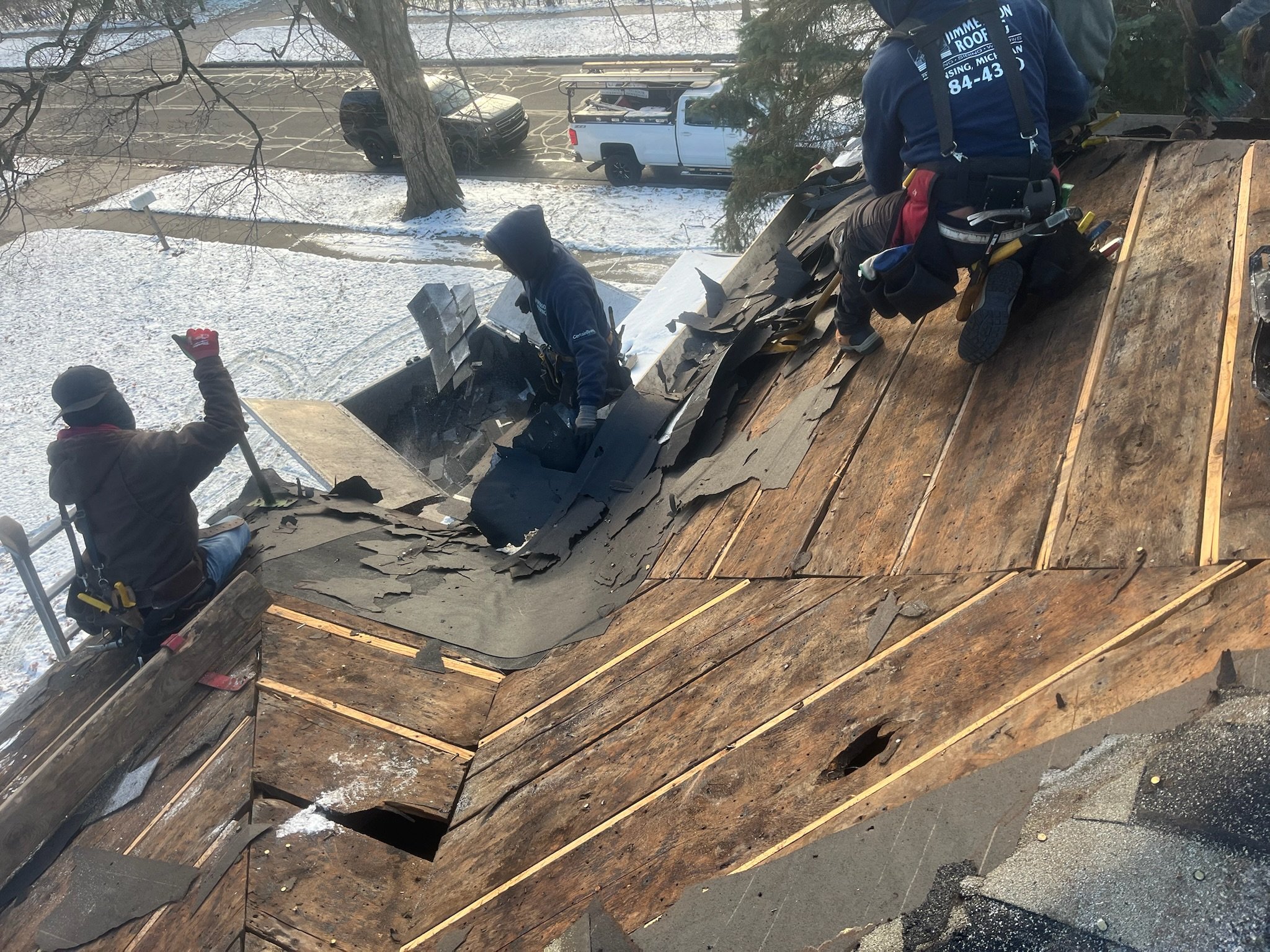
We tear off the old roof rather than laying over it, because a layover hides the deck and the deck is where the real problems live. We inspect the sheathing and replace anything soft or delaminated. We run ice and water membrane where it belongs, and in Michigan that is not optional. Ice dams at the eaves are how most of the interior damage we see got started.
Then underlayment, drip edge, and new flashing. We do not reuse old flashing to save an hour. Starter course, field shingles, hips and ridge. We correct the ventilation while we are up there, adding ridge vents and making sure the intake at the soffits is actually open, because that is what keeps the new roof from aging as fast as the old one did.
Then we clean up. Magnet through the yard, debris hauled off, driveway swept.
We install CertainTeed products including the Landmark line, which carries a limited lifetime warranty. Permit requirements vary across Eaton, Ingham, and Clinton counties, and we sort that out before anybody swings a hammer.
When we are done, keep every piece of paper: the paid invoice, the signed contract, the install date, permits, warranty documents, and the completion photos. Send copies to your carrier and then follow up until someone confirms in writing that they updated your roof year. That last step gets skipped constantly and it is the whole point of the exercise.
What We Tell Homeowners Holding a Non-Renewal Letter
You are on a clock, usually 30 to 60 days. Do these in order.
Call your agent and ask exactly what work or paperwork makes this go away. Get a specific answer, not a general one.
If they made the call off aerial or satellite photos, ask to see the images. Mere cosmetic roof issues, such as discoloration or streaking, are not valid grounds for policy cancellation or nonrenewal.
Get somebody on a ladder. Not a drone flyover, not a walk around the yard. Have them evaluate the shingles, flashing, penetrations, decking, ventilation, gutters, fascia, soffits, and look in the attic.
Start shopping for other carriers the same week. Underwriting rules are not uniform and another company may see your roof differently.
Do not file a claim just because you got the letter. Wear and age are not the same thing as storm damage, and a denied claim on your record does not help you.
If your carrier will not explain itself, the Michigan Department of Insurance and Financial Services consumer hotline is 877-999-6442.
Look at the Siding While the Ladders Are Up
Underwriters do not stop at the roofline, and neither do we.
Rotted fascia, sagging soffit, cracked or loose vinyl, and beat up trim all land in the same condition report as the shingles. And practically speaking, the fascia and soffit are the exact seam where the roof and the siding meet. Correcting your attic intake ventilation is far easier when a crew is already working that edge, so doing both at once saves you money and saves you a second repair.
We install vinyl siding from CertainTeed, backed by a manufacturer lifetime warranty and fade warranty, and built for what Michigan throws at a house. If your carrier flagged overall property condition rather than the roof specifically, have somebody walk the entire exterior once instead of chasing one item at a time.
Get an Honest Look Before Your Deadline
Exteriors of Lansing is a locally owned roofing and siding company, licensed and insured, serving Greater Lansing, Grand Ledge, DeWitt, Okemos, Haslett, and the surrounding communities since 2000. Our owner Tim Booth was born and raised in mid Michigan, we are local people doing local business.
Every job starts with a free estimate and a straight answer. Sometimes the answer is that you need a roof. Sometimes it is that you need a repair and have a few good years left, and we will put that in writing for you to forward to your agent. We would rather keep a neighbor than sell a roof that is not needed yet.
You are also welcome to stop by our Grand Ledge showroom and put your hands on the shingles and siding before you decide anything.
Holding a non-renewal letter, or watching your roof creep up on an age threshold? Call us at 517-371-3100 for a free estimate.
This article is general information from a roofing contractor, not legal or insurance advice. Coverage and underwriting rules vary by company and by policy, so confirm specifics with your agent.
Frequently Asked Questions
-
Roof age is rarely the only factor, but it is often the trigger. Carriers weigh age together with condition, materials, maintenance, and installation records under their own underwriting rules. Michigan does not set one universal cutoff, which is why your neighbor with the same roof can get a completely different letter than you did.
-
Around 15 years is when we start seeing requests for photos, records, or an inspection. At 20 years and past it, replacement requirements and coverage restrictions get a lot more common. Ventilation and installation quality can push a specific roof to either side of that range.
-
No. A repair fixes the damage, it does not change the year the roof went on, and that install year is what your carrier tracks. If a carrier tells you a particular repair satisfies them, get that in writing before you authorize the work.
-
No contractor can promise you that, and you should be wary of one who does. A complete, well documented replacement usually clears the roof related requirement, but the insurance company still controls eligibility, pricing, and deductibles. What we can control is doing the job right and giving you clean paperwork.
-
The paid invoice, signed contract, install date, permit and inspection records, material and warranty information, and dated completion photos. Then follow up until someone confirms in writing that your roof year has been updated in their system.
-
They can. Rotted fascia, damaged soffit, and failing siding all feed into the same overall condition assessment as your roof. If you are getting the roof done anyway, it is usually worth having the whole exterior looked at in one visit.