Does Vinyl Siding Fade in Michigan? What to Know Before You Pick a Color
Yes, vinyl siding fades, but good siding fades so slowly most Mid Michigan homeowners never notice it. Sunlight breaks down pigment, so the south and west walls change first. Cheap siding can look chalky and washed out in under ten years. Quality siding is different: CertainTeed's vinyl siding warranty covers color change beyond 4 Hunter units. Here at Exteriors of Lansing in Grand Ledge, we tell customers that the product, the color, and the install decide which result you get.
The short version:
• All vinyl siding fades a little. Quality siding fades so slowly you will not see it happen.
• A lot of what looks like fading is dirt, pollen, and mildew. Soap and water brings the color back.
• Dark colors like navy and charcoal hold up fine on Michigan houses when they come on a siding line made for deep colors.
• A fade warranty covers excessive fading, not normal weathering. Bad installs and skipped cleaning can void the warranty.
Why does vinyl siding fade?
Vinyl siding fades because ultraviolet light slowly breaks down the pigment in the panel. The walls that get the most sun age fastest. On most Mid Michigan houses that means the south and west sides.
Twenty years in, you can sometimes see the difference between a west wall and a north wall on the same house. On good siding that difference is small. On bottom shelf siding fading shows up much sooner and is much more prominent.
Is my siding faded, or just dirty?
Most dull looking siding is dirty, not faded. Pollen, road grime, and mildew build up on the surface and make any color look tired. Wash a small patch with soap, water, and a soft brush. If the color comes right back, your siding was never faded in the first place.
Chalky residue is the other thing people mistake for fading. It washes off too. Real pigment loss is the one thing that does not come back with cleaning.
Does dark siding fade faster than light siding?
Dark siding does not always fade faster, but color change is easier to see on it. A deep, saturated color has more pigment to lose than a soft cream. Dark walls also run hotter in direct sun, which puts more heat stress on the panel.
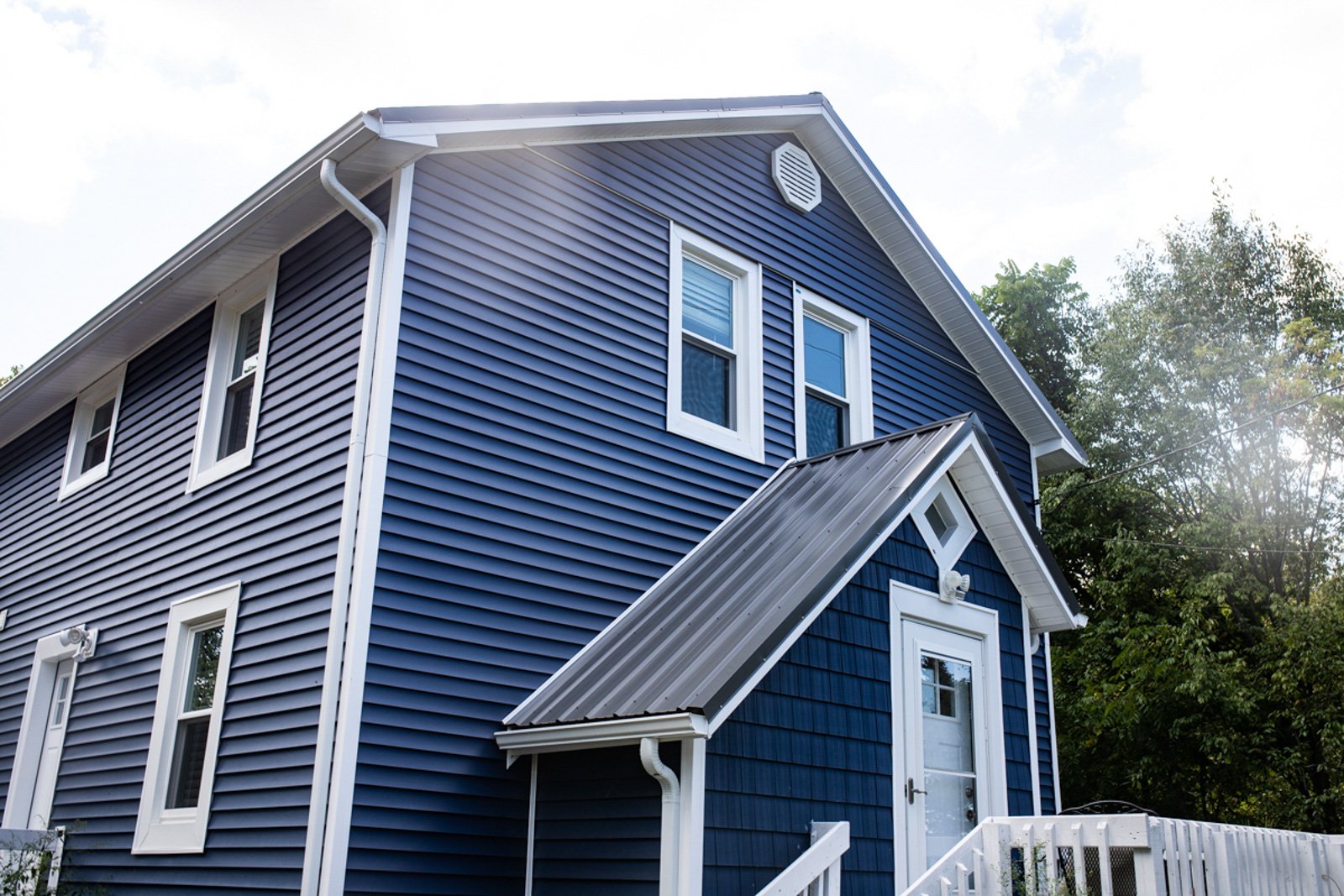
That does not make dark siding a bad idea in Michigan. Dark blue and charcoal are two of the most popular colors, both are fine choices.
The key is buying the right product instead of the cheapest one. CertainTeed's Restoration Classic line carries dark colors like Midnight Blue, Pacific Blue, and Charcoal Gray. Sterling Gray is a good middle option if you want gray without going all the way to charcoal.
Do not talk yourself out of a color you love. Ask which line it comes on.
Which siding colors hide fading best?
Light neutrals hide fading best. White, cream, and light gray show the least change over the years because small color shifts are hard to see on pale shades. They also go with almost any roof.
Here is how the common colors stack up, from most forgiving to least.
White, cream, and light gray. You will barely see any change, even after many years.
Taupe, medium gray, and sandstone. Very little change shows. These are a good pick if you want a little more color without the worry.
Sage, clay, and softer blues. Some change can show over many years. They give the house more character on the street.
Navy, charcoal, deep green, and black. Change is easiest to see on these dark shades. They look great, so pick them on a siding line made for deep colors.
Manufacturers add and drop colors from year to year, so check which colors are available now before you fall for one. When you narrow it down, look at a real sample in person. Pictures on your phone are bad at showing color, especially dark shades.
Want to see charcoal on a full wall instead of a two inch chip? Come by our showroom at 13150 Lawson Rd in Grand Ledge.
What does a siding fade warranty actually cover?
A siding fade warranty covers excessive fading, not normal weathering. Every manufacturer expects some color change over the decades, and that normal change is excluded. The warranty only kicks in once the fade passes a measured threshold.
That threshold is measured, not eyeballed. CertainTeed’s vinyl siding warranty defines excess fade as a color change greater than 4 Hunter units, calculated under a lab standard called ASTM D2244. Other manufacturers set their own thresholds, and coverage, limits, and exclusions can differ from one product line to the next, even within the same brand. The manufacturer’s written warranty for your exact product is what governs your coverage, not the brochure and not the sales pitch.
Before you sign, ask for that warranty document for the exact product and color you are buying. Then check these common exclusions:
• Improper installation. The siding has to go up per the manufacturer's written instructions. That part is on your contractor.
• Skipped maintenance. Most fade warranties expect you to clean the siding periodically.
• Painting over it. Painting or coating over the factory finish can void the warranty.
• Harsh chemicals. Strong cleaners and chemical damage are excluded.
• Mildew and air pollution. Staining from these counts as normal weathering, not fade.
What does a Michigan year do to vinyl siding?
A Michigan year makes vinyl siding move constantly. A house in Lansing or DeWitt goes through ninety degree July afternoons and subzero January mornings in the same twelve months. Vinyl expands in the heat and shrinks in the cold, every single day.
Then February and March bring the freeze and thaw cycle. It thaws Tuesday, refreezes Wednesday night, and your siding works the whole time.
Movement is not fading. But it is the reason installation matters as much as the product does.
Does installation affect how long siding looks good?
Installation decides whether vinyl siding stays flat for fifteen years or starts waving in two. Vinyl has to be hung loose enough to move. Nail it too tight and the panels cannot expand when July hits.
What you get then is waviness, buckling, and distortion. No color technology on earth fixes a bad nailing job. A bad install can also void the manufacturer warranty, which leaves you holding the bill.
We install to manufacturer specifications because that keeps the warranty good and keeps the wall looking right in year fifteen. Our crews show up when we say we will, and they clean up the site before they leave each day.
How do I pick a siding color that works with my roof?
Pick your siding color to match your roof, because the roof is usually the part of the house you are not replacing. Warm roofs pair best with warm siding, and cool roofs pair best with cool siding. Then check the color against everything else staying on the house before you commit.
Here is the order we walk Mid Michigan homeowners through at our Grand Ledge showroom.
Start with the roof. Shingles with warm brown or bronze tones clash with cool gray siding and can make the two look like they belong to different houses. A true charcoal roof pairs well with darker siding and pulls the whole exterior together.
Check what else is staying. Brick, stone, windows, doors, trim, gutters, soffit, and fascia all have to work with the new siding color. Those details decide whether the finished house looks planned or just assembled.
Look at samples outside at different times of day. View siding samples in full sun, in shade, early in the morning, and around dinner time. A charcoal that looks perfect at noon can read almost black at six o'clock.
If your roof is also getting old, factor that in. Exteriors of Lansing does roofing too. If your roof has five or six good years left, we will tell you which shingle colors will still work with your new siding. If both are close to the end of their lifespan, it can make sense to plan them together so you are not guessing at a color match later.
Come See the Colors in Person
There is no reason to settle for beige because you are worried about fading. Navy, charcoal, and deep green all hold up on Michigan houses when the product is built for them, the warranty has teeth, and the color works with your roof.
We have been installing siding on houses around Grand Ledge, Lansing, DeWitt, Okemos, and Haslett for over 25 years. Come see us at the showroom, or give us a call at (517) 371-3100 for a free estimate. Licensed, insured, and BBB A+ accredited. No pressure and no runaround.
This post is meant to provide general information from our experience installing siding in Mid Michigan, not legal or warranty advice. Warranty terms change and vary by product line and color, so the actual warranty document for the siding you buy is what counts. If you have questions about your coverage, check with the manufacturer or give us a call.
Frequently Asked Questions
-
On quality vinyl siding, fading is so gradual that most homeowners never notice it. Bottom shelf siding can look washed out inside of ten years, which is one reason the cheap quote is rarely the cheap job.
-
You can, but painting over the factory finish can void a CertainTeed siding warranty. Wash it first, since cleaning fixes a lot of what looks like fading. If the pigment is truly gone and the siding is old, replacement is usually the better use of money.
-
Soap, water, and a soft brush handle most of it. Go easy with a pressure washer, because too much pressure drives water up behind the panels. Skip harsh chemical cleaners, which can damage the finish and cause problems with the warranty.
-
Usually not. CertainTeed's vinyl siding warranty states that its fade coverage does not transfer to the next owner, even though other parts of the warranty do. Ask for the warranty document for your exact line to be sure.
-
Not always, but ask before you pick a siding color. If your roof is close to done, doing both together keeps you from matching new siding to a shingle you are about to tear off. Give us a call and we will tell you honestly if one can wait.